
How AI Websites Work: Why the Next Generation of Business Websites Will Think, Adapt, and Sell
By Scott Rosendahl | TeamThinkTank.ai
For most of the internet's history, websites have been little more than digital brochures. Some were beautiful. Some converted well. But fundamentally, they were static experiences waiting for visitors to arrive and hopefully take action.
Even the most advanced websites of the last decade largely followed this same pattern. A visitor would arrive. The site would present information. The outcome depended largely on whether the visitor chose to move forward.
Artificial Intelligence is quietly rewriting that model.
The next generation of business websites will not simply display information. They will interpret behavior. They will adapt messaging. They will guide decision-making. They will function less like brochures and more like intelligent front offices capable of qualifying prospects, answering questions, and moving opportunities forward even when no human is present.
From Static Pages to Intelligent Interfaces
Historically, websites have operated on a publish-and-present model. Businesses organized information into pages and relied on visitors to navigate toward relevance. SEO, conversion rate optimization, and UX design improved performance, but they still relied on anticipating behavior rather than responding to it in real time.
AI changes that equation. Instead of assuming what visitors want, AI-enabled websites can begin to infer it. A visitor researching pricing may receive different guidance than one exploring services broadly. Someone returning may encounter a different experience than someone arriving for the first time.
Treats all visitors similarly. Presents the same information regardless of intent, behavior, or context.
Treats visitors situationally. Adapts messaging and guidance based on inferred intent and behavior patterns.
The most effective business experiences are not those that present the most information. They are those that present the right information at the right time.
What Actually Makes a Website "AI-Powered"
There is a great deal of marketing noise surrounding AI websites. But the real transformation occurs at a deeper architectural level. An AI website introduces intelligence in three critical ways.
AI systems interpret behavior rather than simply record it. Traditional analytics show where users click. AI systems begin identifying why those clicks matter — detecting hesitation, repeated visits, or patterns indicating decision readiness.
Once intent is understood, the website adjusts how it responds. Dynamically highlighting relevant services, offering contextual explanations, or prioritizing calls to action based on inferred needs.
AI websites move beyond experience into operations. Qualifying leads, preparing internal notes for sales teams, initiating follow-up sequences, and integrating visitor insights into business systems automatically.
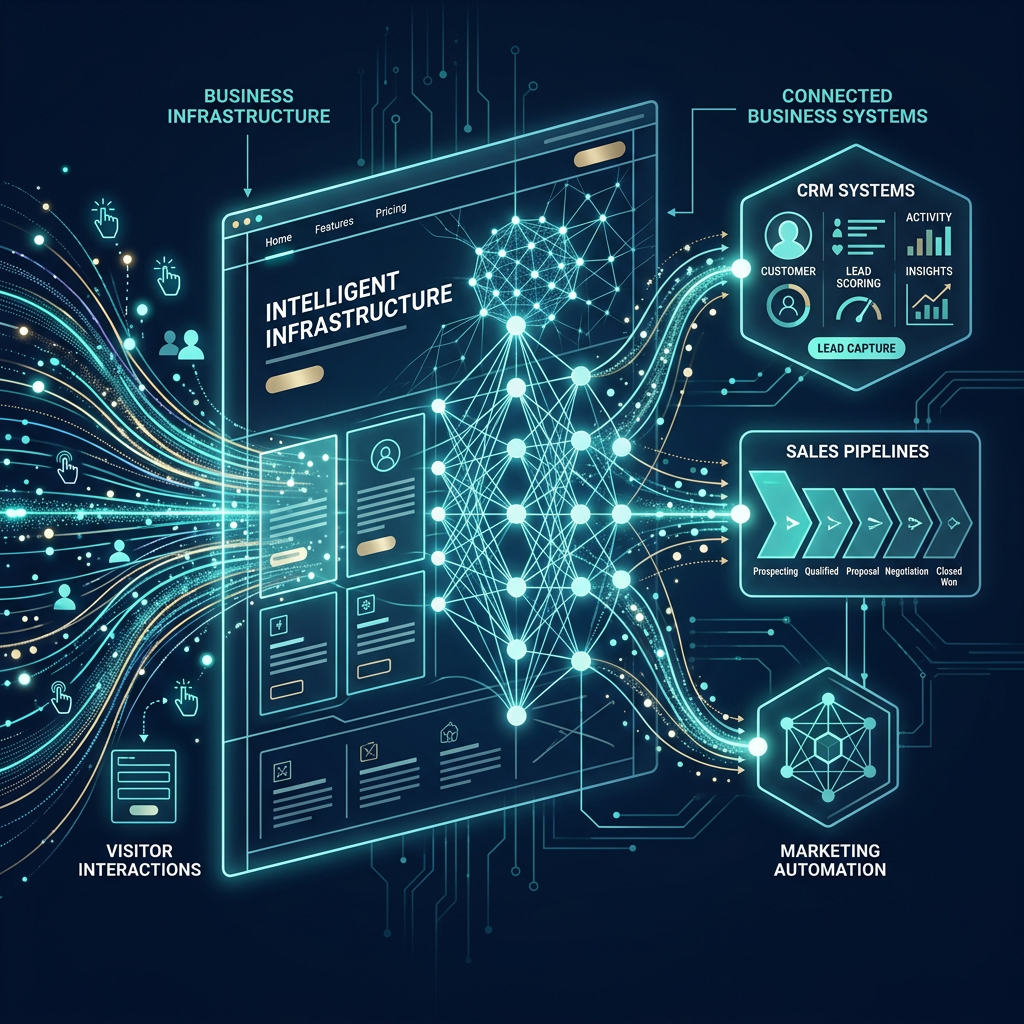
Why AI Websites Are Becoming Business Infrastructure
What many organizations are beginning to realize is that their website is often the most underutilized operational asset they possess. It is typically the first point of contact with customers, yet it remains disconnected from the systems that actually move business forward.
Consider how much potential intelligence exists in website interactions. Prospects reveal what they care about through navigation patterns. Customers signal needs through support inquiries. Partners reveal interest through content engagement. Historically, much of this was lost because websites lacked the ability to interpret it meaningfully.
This is why AI websites are increasingly being viewed not as marketing assets, but as revenue infrastructure. They help businesses move from reactive follow-up to proactive awareness.
The Strategic Advantage Most Businesses Are Missing
Perhaps the most overlooked benefit of AI websites is not automation or efficiency. It is awareness.
Organizations often operate with incomplete visibility into what prospects experience before direct contact occurs. Sales teams may only see opportunities once forms are submitted. Leadership may only see trends once they appear in reports.
AI websites begin closing this visibility gap — providing early signals about what services attract attention, what objections appear frequently, where visitors hesitate, and which audiences convert fastest.
Designing AI Websites That Actually Create Value
One of the reasons many AI website projects fail is that they focus on adding features rather than redesigning experiences. Adding AI to a poorly structured website rarely produces meaningful improvement. Designing a website around intelligence from the beginning often does.
Effective AI websites are defined by how intelligence flows through the entire experience. From the moment a visitor arrives, the site should begin helping them orient, understand relevance, and move toward clarity.
What questions should the site help answer?
What uncertainty should it reduce?
What signals should it capture?
Where should human interaction be introduced?
The most successful AI websites feel less like digital brochures and more like well-run front offices. Good AI design does not feel mechanical. It feels helpful.
The Future of Business Websites
Looking forward, the distinction between websites and business systems will likely disappear altogether. The most effective organizations will operate digital environments where marketing, sales, service, and operations intersect seamlessly.
The companies that succeed in this transition will not be those chasing novelty. They will be those asking a more grounded question:
How can our website help our business operate better?
Scott helps businesses build AI systems that generate revenue and eliminate operational friction. Based in Tigard, Oregon.

